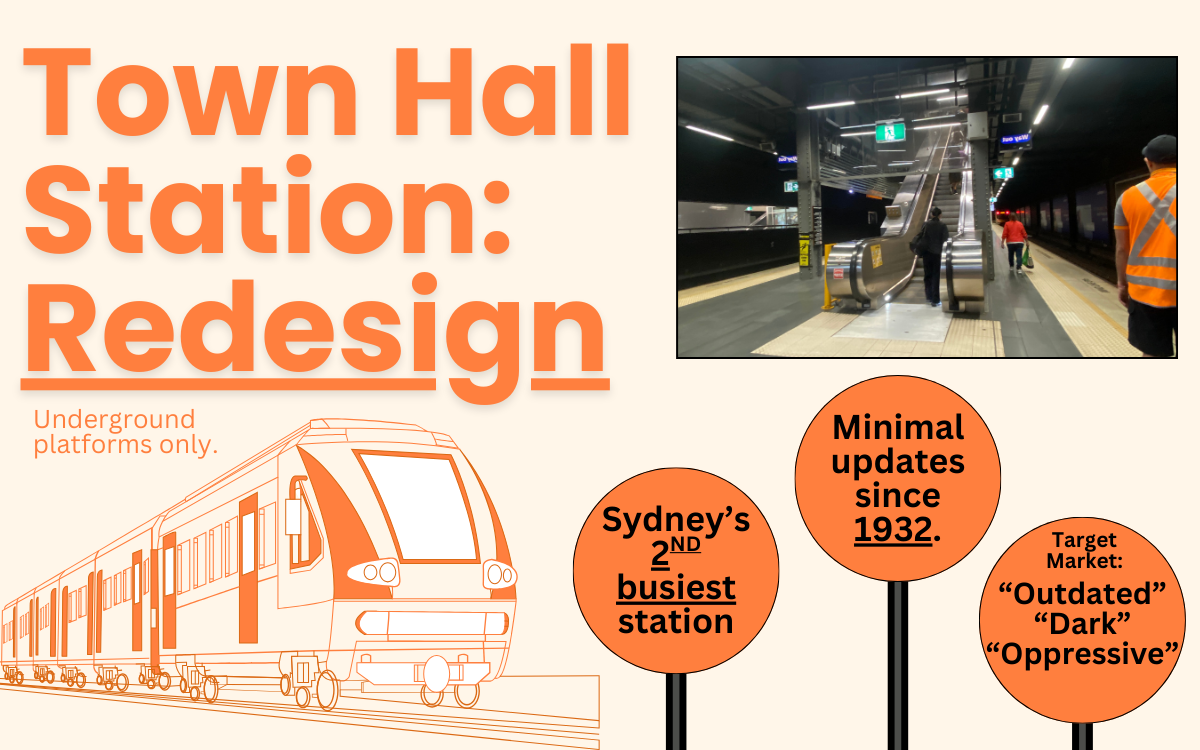



Town Hall Station redesign: for user wellbeing

post-image

Between 2001-2023, 1,685 suicides occurred on Australia’s railways, accounting for 72% of all rail-based fatalities (Tracksafe,2024). This alarming statistic motivated me to explore how transport environments influence the well-being and safety of commuters. My project aims to redesign the underground platforms of Town Hall Station to create a more supportive commuter experience.

To support my project, I am seeking access to station plans and measurements, user groups for survey and testing, advice on materials, lighting strategies, biophilic integration, and well-being-centred design. I am also looking for practical guidance with 3D digital modelling software. Any professional support would be greatly appreciated.


What do you think?


You must be logged in to post a comment.
Comments
Peter Murphy @ 2026.02.11 8:49 AM

This is a really strong and thoughtful design challenge. You have chosen a real issue that matters, and why the station environment can influence people’s wellbeing and safety. 

Your idea connects well with a previous station design competition in Melbourne, Station Ideation, run by Dept of Ed and DATTA Vic. Some of the archived resources may be useful for inspiration and process as you develop your ideas: https://www.datta.vic.edu.au/Station-Ideation

Keep building on this direction, stay focused on the commuter experience, and use your design decisions to show how public transport spaces can better support people and the planet.

Peter Murphy,  RMIT University


Steve B @ 2026.02.16 2:16 PM

Alanah, this is a great topic to explore and has broader applications beyond mental health. I can't provide access to plans and the like, but I can offer the following advice:

- you are attempting to design an intervention at the very critical moment in the person's decision-making. Changes to the environment can help, and you should consider clear links to services like Lifeline for people actively considering self-harm;

- we know that people in underground environments respond positively to the introduction of natural lighting, and living things such as plants, and also to water and natural sounds. Lighting and other techniques to minim natural environments are a reasonable backup plan;

- warm materials, such as wood and sandstone, can improve people's sense of calm and well-being

- increasing the oxygen content in the air, and vigorously reducing the levels of CO2 (a real problem in a busy, crowded, underground space like Town Hall station) can also help improve general sense of wellbeing.

Other things to consider:

- Town Hall is full of people, but that can actually contribute to a sense of loneliness and isolation. There are people everywhere, but you have no-one to talk to.

- Take a look at the new Metro platforms and the way in which the tracks are screened off. Doors only open when the train has arrived and reached a stop; there are no gaps between train and platform. 

Steve


Alanah @ 2026.02.27 5:01 AM
Thank you @Peter Murphy. This is a really interesting resource and has inspired perspectives and designs I wouldn't have thought of. Can't wait to add these insights to my folio, thank you for the advice!

Alanah @ 2026.02.27 5:14 AM

Thank you, @Steve B,

Your point on Lifeline inclusion and possible solutions for loneliness is very interesting, and I will investigate this further to find ways I could integrate this into my designs. I have researched biophilic design inclusions in train stations and can't find many examples of living or moving elements in underground environments. I'll need to research further to see if it's feasible for Town Hall Station; however, sensory features, lighting or natural materials, like you pointed out, might be more maintainable. Thank you again for your advice; it will inform parts of my research and help with initial designs greatly. :)


Related Posts

2026

post-image

Stair Energy Generator (SEG)
2 March 2026 by BowieW 0 Comments

2026

post-image

Water Dissolvable PLU Apple Stickers
27 February 2026 by Issy 0 Comments

2026

post-image

Supporting the recovery and pain relief of acute musculoskeletal-based shoulder injuries
23 February 2026 by Ash 0 Comments